The Legal Preliminaries to Marriage
For your marriage to be legally recognised in England or Wales, there are certain formalities that are required by law.
You both need to attend the Register Office in the district in which you have had your usual residence for the preceding seven days to inform them of your intention to marry. This is called giving notice. Giving notice means declaring that you are free to marry and requires you to provide certain documents. This notice has to be given up to one year before the day of your wedding. 28 clear days must pass before the Registrar’s certificates can be issued and you are able to marry.
Documents to be produced
• Evidence of name, age and nationality; if born on or before 31 December 1982, your valid passport or your valid identity card or your Full Birth Certificate
• Evidence of name, age and nationality; if born on or after 1 January 1983, your valid passport or your Full Birth Certificate and your Mother’s Birth Certificate
• Home Office documentation where applicable
• If you have changed your name a Deed Poll or Statutory Declaration
• Decree Absolute(s)
• Documents regarding civil partnership(s)
• Death Certificate(s) of Wife, Husband or Civil Partner
• Documents regarding your Marriage to each other abroad
• Completed Parent Consent(s) forms where applicable
• Proof of Address, i.e. Council Tax bill, rent book, utility bill or bank statement
https://www.gov.uk/get-married-in-england-or-wales
Contact your local register office to make an appointment.
You both need to attend the Register Office in the district in which you have had your usual residence for the preceding seven days to inform them of your intention to marry. This is called giving notice. Giving notice means declaring that you are free to marry and requires you to provide certain documents. This notice has to be given up to one year before the day of your wedding. 28 clear days must pass before the Registrar’s certificates can be issued and you are able to marry.
Documents to be produced
• Evidence of name, age and nationality; if born on or before 31 December 1982, your valid passport or your valid identity card or your Full Birth Certificate
• Evidence of name, age and nationality; if born on or after 1 January 1983, your valid passport or your Full Birth Certificate and your Mother’s Birth Certificate
• Home Office documentation where applicable
• If you have changed your name a Deed Poll or Statutory Declaration
• Decree Absolute(s)
• Documents regarding civil partnership(s)
• Death Certificate(s) of Wife, Husband or Civil Partner
• Documents regarding your Marriage to each other abroad
• Completed Parent Consent(s) forms where applicable
• Proof of Address, i.e. Council Tax bill, rent book, utility bill or bank statement
https://www.gov.uk/get-married-in-england-or-wales
Contact your local register office to make an appointment.
History
In 1994 The laws in the United Kingdom changed, allowing licensed venues other than register offices to be used for civil marriage ceremonies.
However the content of the ceremony remains pretty much unchanged, and this type of Marriage or Civil Partnership Service can often be uninspiring and lack the pomp and flair that many couple rightly feel their relationship deserves.
What is not so commonly known or understood in this country - is that ONLY the *Declaratory Words, and the **Contracting words have to be said in a Register Office or licenced venue, in order for your marriage to be recognised in law and for a marriage certificate to be issued
However the content of the ceremony remains pretty much unchanged, and this type of Marriage or Civil Partnership Service can often be uninspiring and lack the pomp and flair that many couple rightly feel their relationship deserves.
What is not so commonly known or understood in this country - is that ONLY the *Declaratory Words, and the **Contracting words have to be said in a Register Office or licenced venue, in order for your marriage to be recognised in law and for a marriage certificate to be issued
Contractual Words
There are two sets of phrases that must be included in order to make a wedding ceremony legally binding. You can choose to have them traditional, modern, or simplified.
DeclarationThe declaration makes sure that there is no reason against your marriage.
These words are the legal requirements for marriage, as well as formally identifying yourselves to the registrar and signing the marriage/civil partnership register in front of two independent witnesses and a registrar.
*Declaratory Words
“I do solemnly declare that I know not of any lawful impediment why I (…) may not be joined in matrimony to (…).”
“I declare that I know of no legal reason why I (…) may not be joined in marriage to (…).”
Replying “I am” to “Are you (…) free, lawfully, to marry (…)? ”
Contracting wordsAs with any legal contract, there is a promise to be made. Each partner repeats these words to the other, often with the registrar prompting.
**Contracting Words
I call upon these persons, here present, to witness that I (…) do take thee (…) to be my lawful wedded wife/husband.”
“I (…), take you (…) to be my wedded wife/husband.”
Or, “I (…) take thee (…) to be my wedded wife/husband.”
DeclarationThe declaration makes sure that there is no reason against your marriage.
These words are the legal requirements for marriage, as well as formally identifying yourselves to the registrar and signing the marriage/civil partnership register in front of two independent witnesses and a registrar.
*Declaratory Words
“I do solemnly declare that I know not of any lawful impediment why I (…) may not be joined in matrimony to (…).”
“I declare that I know of no legal reason why I (…) may not be joined in marriage to (…).”
Replying “I am” to “Are you (…) free, lawfully, to marry (…)? ”
Contracting wordsAs with any legal contract, there is a promise to be made. Each partner repeats these words to the other, often with the registrar prompting.
**Contracting Words
I call upon these persons, here present, to witness that I (…) do take thee (…) to be my lawful wedded wife/husband.”
“I (…), take you (…) to be my wedded wife/husband.”
Or, “I (…) take thee (…) to be my wedded wife/husband.”
And the Rest?

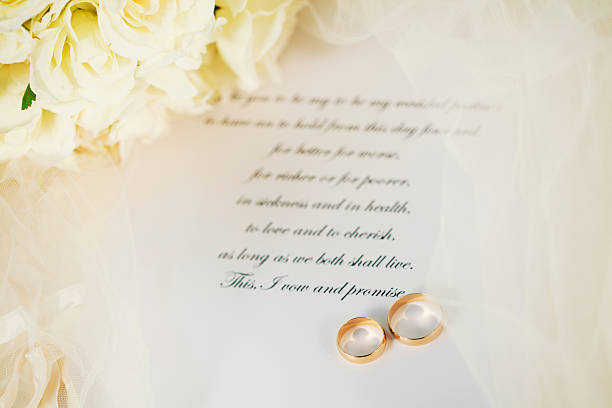
The rest of the service, including the exchanging of rings and saying of vows to one another is purely ceremonial and can therefore take place literally ANYWHERE and at any time of the day or night.... you are limited only by your imagination.
It may be a simple ceremony in your home or garden, or at sunset on the beach with the waves crashing around you, a local beauty spot, or in the middle of a bluebell wood....
It may be a simple ceremony in your home or garden, or at sunset on the beach with the waves crashing around you, a local beauty spot, or in the middle of a bluebell wood....